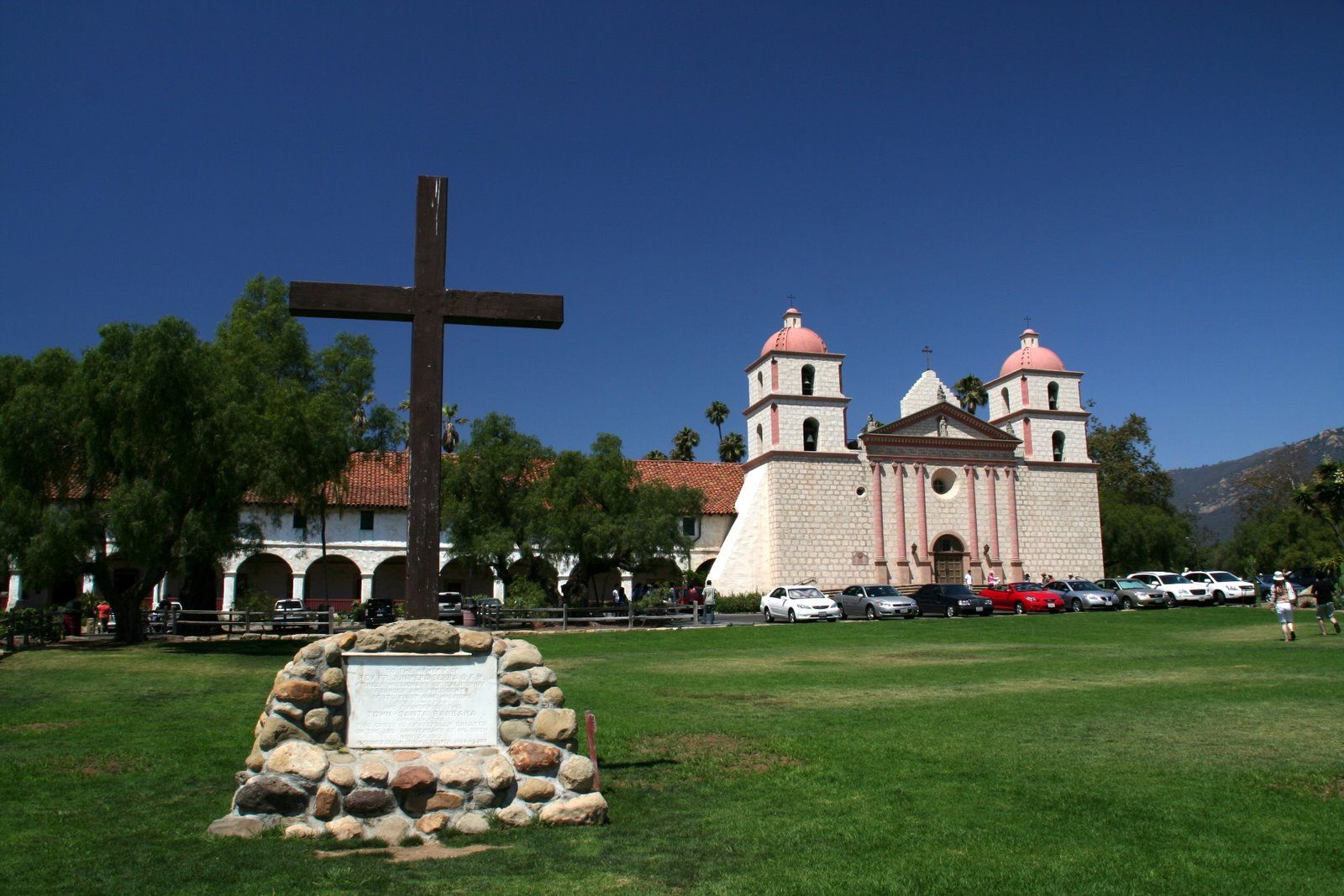
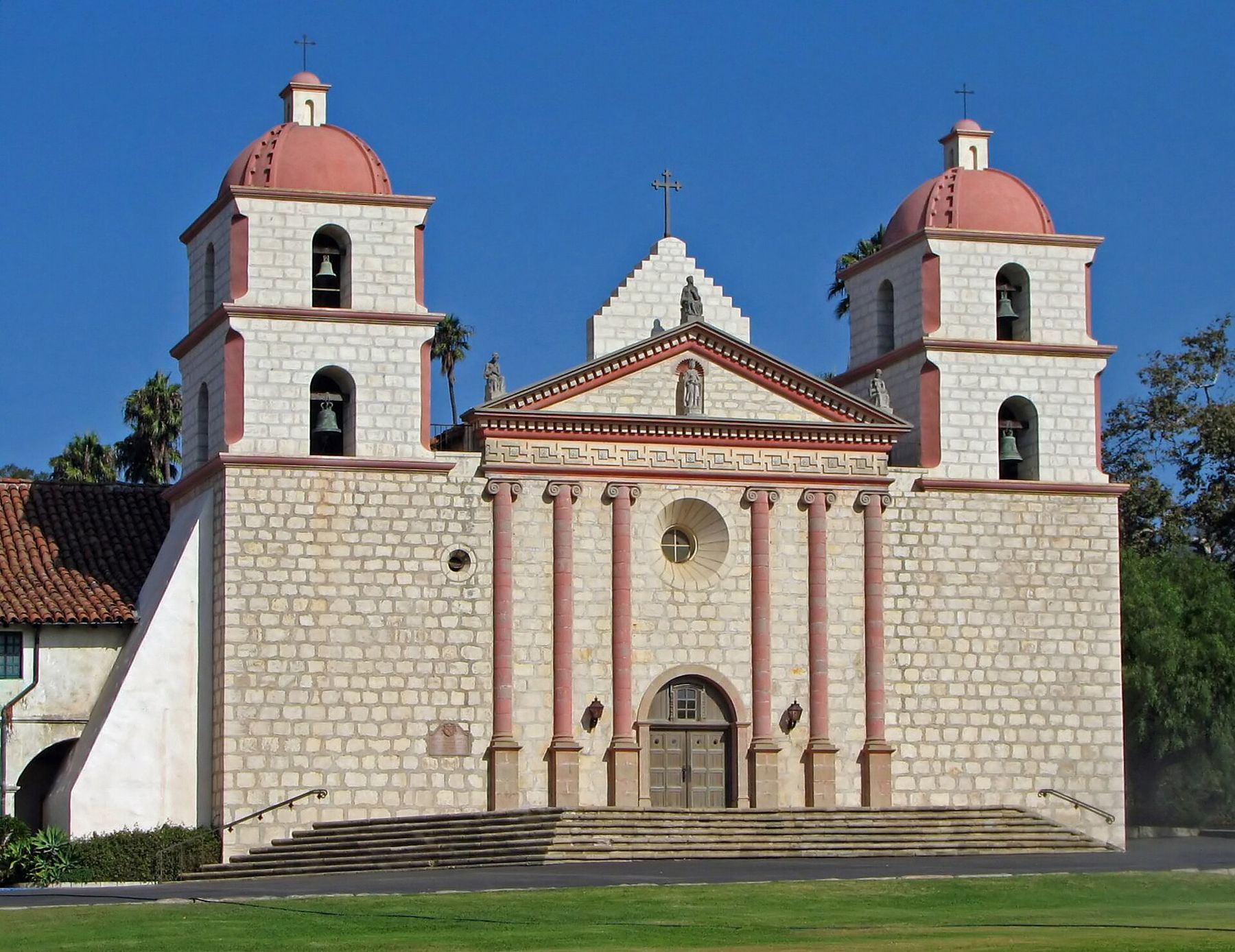
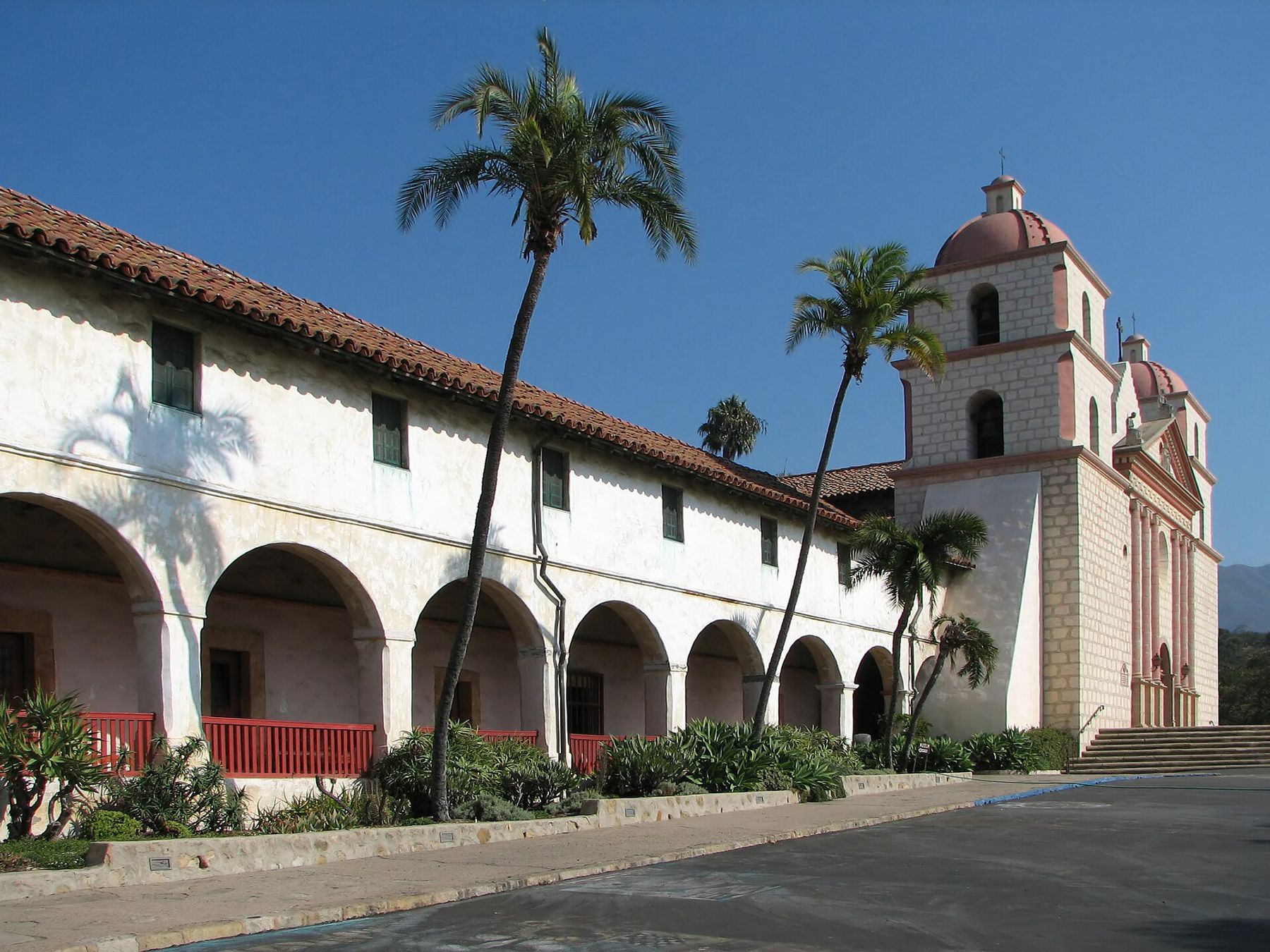
From the lawn in front of Mission Santa Barbara the church looks less like a building than a stage set. A broad stone stair climbs to a facade of six engaged columns and a triangular pediment, with a statue of Saint Barbara at the top. On either side rise twin bell towers, square and pale, with pink domes. The whole front faces the sea. Behind it, close enough to fill the sky, are the mountains.
It has been called the Queen of the Missions for a long time, and it is easy to see why. Of the 21 missions the Spanish founded in Alta California, this is the one that most looks the part.
A mission on the rise
The mission was founded on December 4, 1786, the feast of Saint Barbara, by Father Fermín Francisco de Lasuén, who led the missions after the death of Father Junípero Serra. It was the tenth mission in the chain and was established four years after the presidio down the hill, which was meant to protect it.
The site was chosen for its water and its position, on a gentle rise with a view of the channel. The Chumash people had lived along this coast for thousands of years, and the mission was built to bring them into its religious and working life. Thousands came, and many of them stayed and died here. That is the hard center of the place, and it is worth keeping in mind while admiring the architecture.
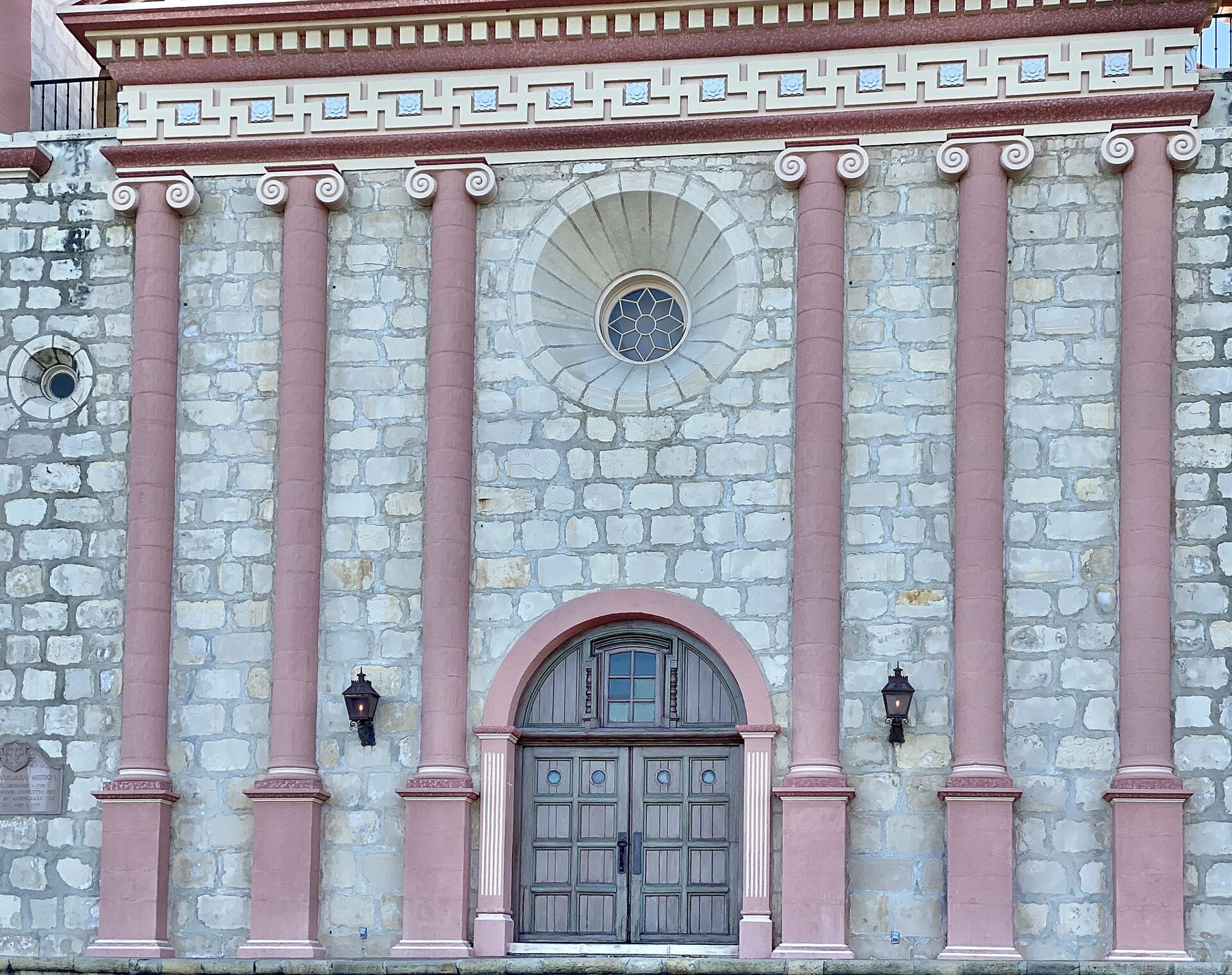
The first churches were adobe and were outgrown or damaged quickly. The earthquakes of 1812 badly damaged the church of the time, and the present stone church was completed in 1820. Its facade was designed by Father Antonio Ripoll, who drew on a Spanish edition of the Roman architect Vitruvius from the mission's library. That classical source explains the columns and pediment, unusual among the California missions.
The twin towers and the earthquake
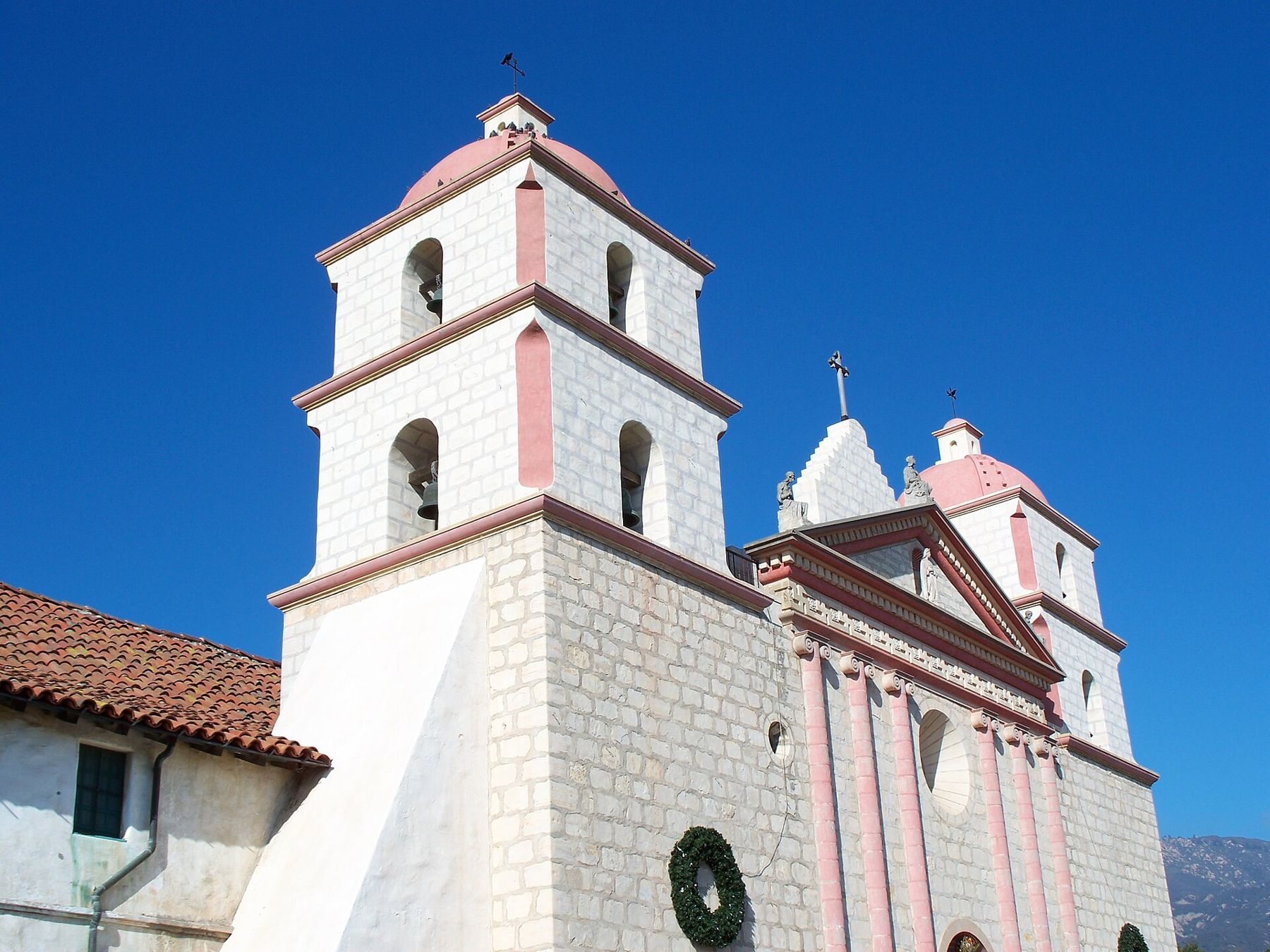
The towers are the mission's signature. Many California missions had one tower, or a wall of bells. Santa Barbara's two matching towers with their domed tops give it a symmetry that photographs well from every angle on the lawn.
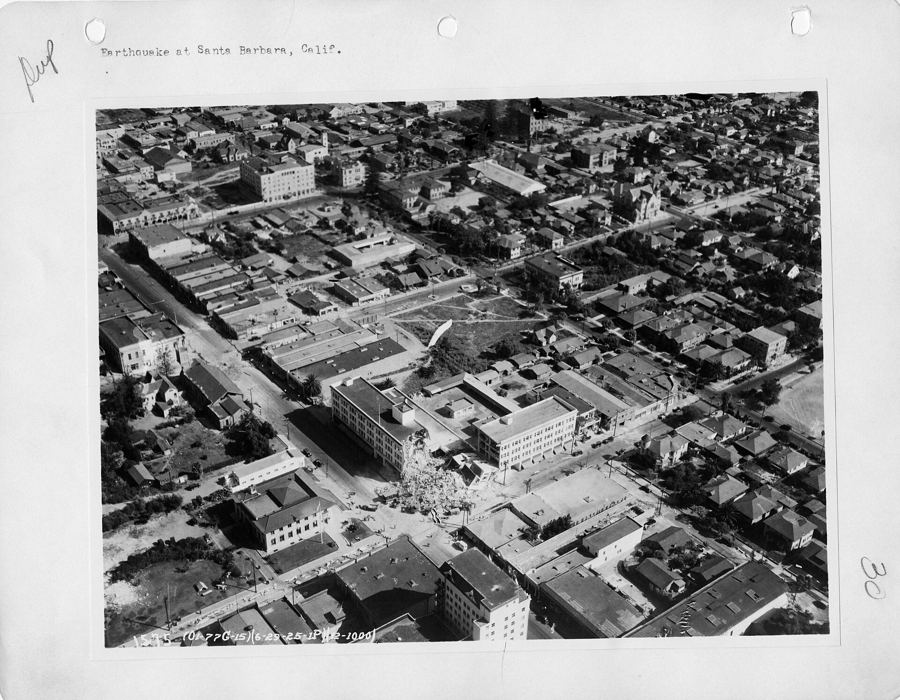
They are not the original towers. The earthquake of June 29, 1925 badly damaged the mission, cracking the towers and the front of the church. They were repaired over the next couple of years, but the concrete used in that work began to deteriorate. In the early 1950s the facade and towers were taken down and rebuilt again, and that is the version standing today.
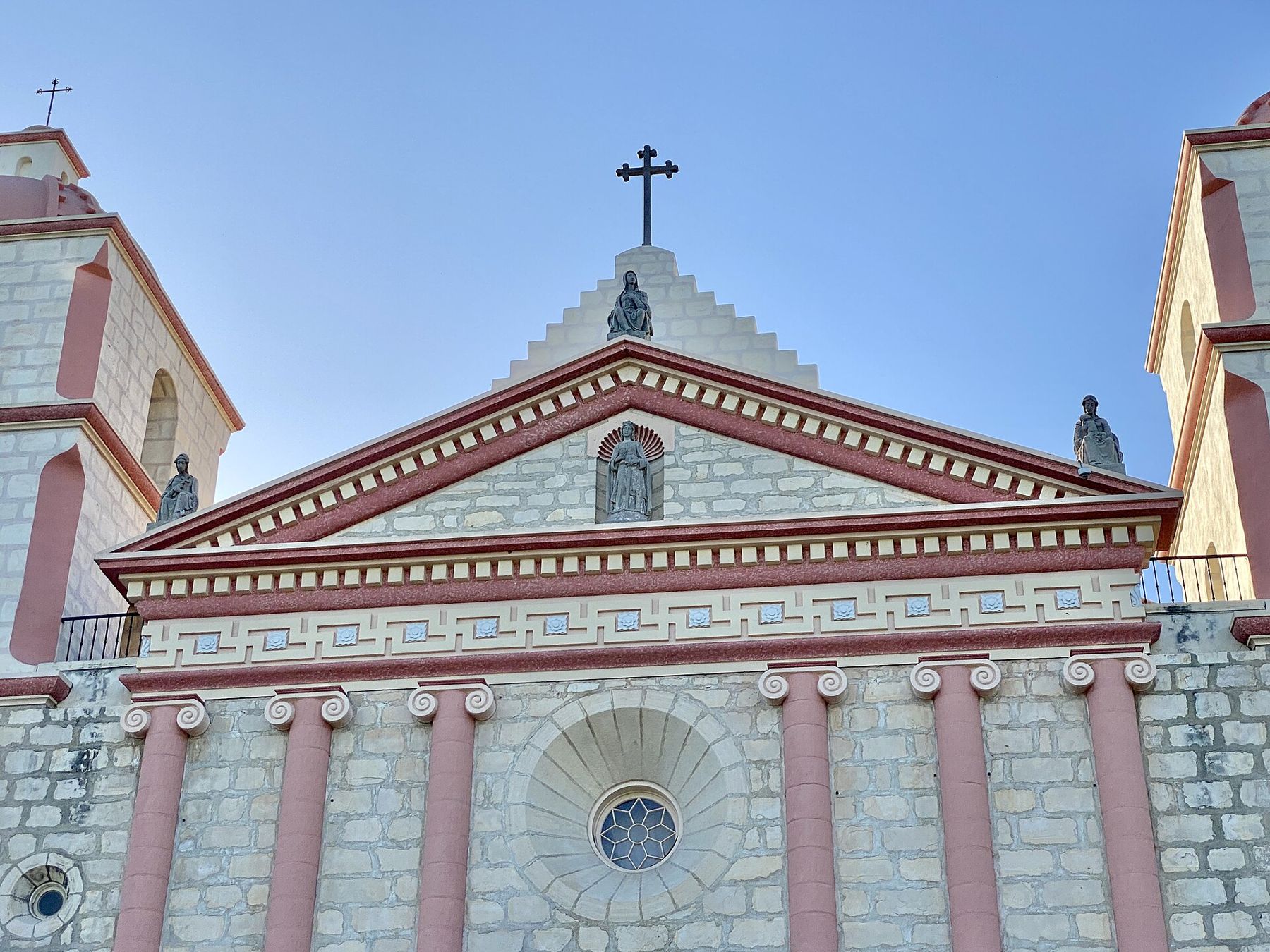
The details reward a close look. Statues stand on the pediment above the door. The pink and cream paint picks out the columns and the edges of the towers.
Unlike most of its sister missions, Santa Barbara never fell completely out of Franciscan hands. Friars have lived and worked here since its founding, and the mission is still an active parish church and friary.
The church inside
The church is long, narrow and high, with thick stone walls and a timber ceiling. Painted decoration runs along the walls, imitating columns, marble and draperies, and the altar at the far end holds statues and paintings from the mission period. Some of the decoration is the work of Chumash artists who painted under the direction of the friars.
The light is low. Windows are few and set high, and on a bright afternoon the shaft from the door lies across the floor like a carpet. Because the church is in use, it may be closed during services, weddings and funerals. Visitors enter as part of the museum route, so be respectful of anyone praying.
The cemetery and the garden
The museum route leads from the church out through a side door into the cemetery. Look up as you pass through: over the doorway are a carved skull and crossbones, an old symbol of mortality.
The cemetery is a walled garden of old trees, roses and gravestones, but most of those buried here have no marker at all. Thousands of Chumash people are buried in this ground, alongside Spanish and Mexican settlers and Franciscan friars. A memorial recognizes the Chumash dead.
One marked grave tells a famous story. Juana Maria, the woman who lived alone on San Nicolas Island for years before being brought to the mainland in 1853, is buried here; she died a few weeks after reaching Santa Barbara. Her story became the basis of the novel Island of the Blue Dolphins.
Thousands of Chumash people are buried in this ground, alongside Spanish and Mexican settlers and Franciscan friars. Give the cemetery more time than it seems to need.
Elsewhere on the route are the Sacred Garden, the old central courtyard where the mission's work once happened, and a small museum of mission life with tools, documents, vestments and Chumash baskets. 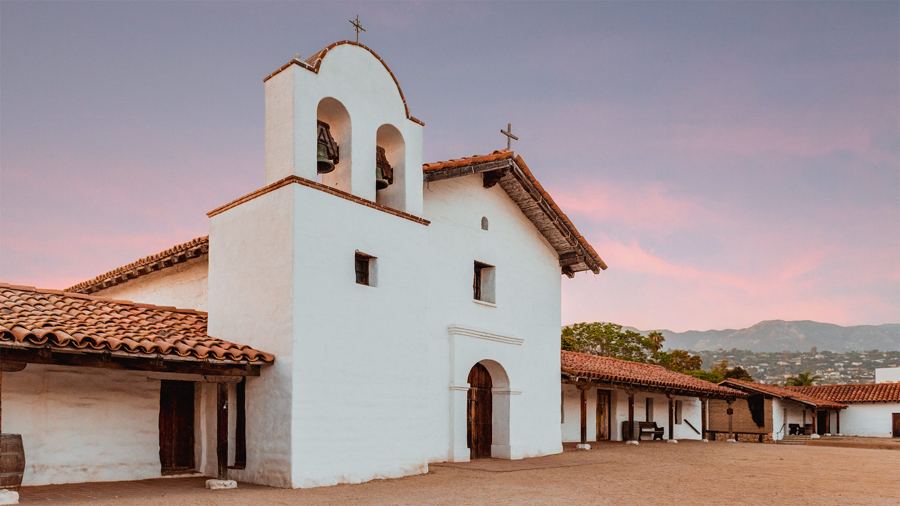 Also on Presidio PostEl Presidio de Santa Bárbara, then and now
The water and the roses
Outside, walk to the front of the mission and look at the stone fountain and the long basin below it, the lavandería, where mission residents once washed clothes. They are part of a water system the friars and Chumash laborers built in the early 1800s. A dam on Mission Creek, built in 1807, still stands in the Santa Barbara Botanic Garden up the canyon, and remains of aqueducts and a reservoir survive near the mission.
The water system mattered as much as the church. It fed the gardens, orchards and fields that kept the mission running. The Chumash who lived at the mission did much of the labor, building the dams, channels and tanks by hand. When you stand by the fountain, look uphill toward the canyon and picture the water coming down to it from the creek, across the slope, through stone channels the whole way.
Across Laguna Street is Mission Historical Park, a broad lawn with a large public rose garden of many hundreds of bushes. It is at its best from late spring through summer, but there is usually something in bloom for much of the year. The lawn is where families picnic, dogs run and photographers set up for the classic view of the facade with the mountains behind.
A visit, hour by hour
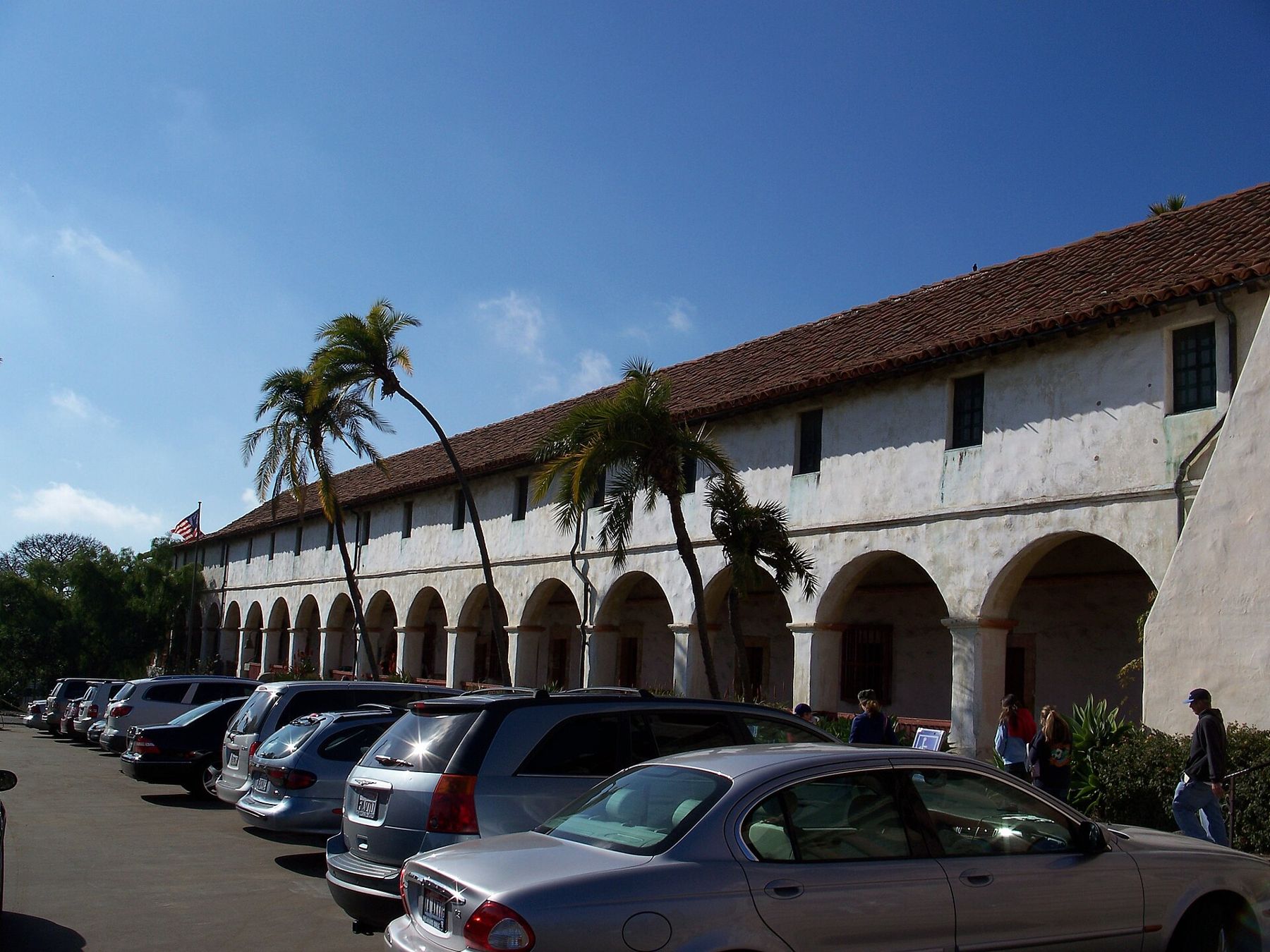
Come in the morning if you can. Start on the lawn of the rose garden, and spend a quarter of an hour looking at the building from a distance as the light comes around onto the facade. Then cross Laguna Street, climb the steps, and look at the fountain and the lavandería on your way to the museum entrance.
The self-guided museum tour takes about an hour at an unhurried pace, through the museum rooms, the Sacred Garden, the church and the cemetery. There is an admission fee, and the hours and prices change from time to time, so check before you go. Docent-led tours are offered on some days.
After that, walk up the hill. The Santa Barbara Museum of Natural History sits in the oak woods of Mission Canyon a few minutes away, and the Botanic Garden is farther up the canyon by car. Or simply sit on the low wall in front of the mission and look back the way you came, down the long slope of the city to the sea.
The mission is about a mile and a half from downtown. Walking up from State Street takes about forty minutes, mostly uphill. City buses run nearby on schedules that change. In late May the plaza in front hosts a chalk-painting festival that covers the pavement in color, and in August the mission steps are the setting for the opening night of Old Spanish Days.
The mission works well with the rest of old Santa Barbara. Pair it with the presidio, the fort built to protect it, and with the story of the 1925 earthquake that brought down the towers and helped decide how the city below would look.
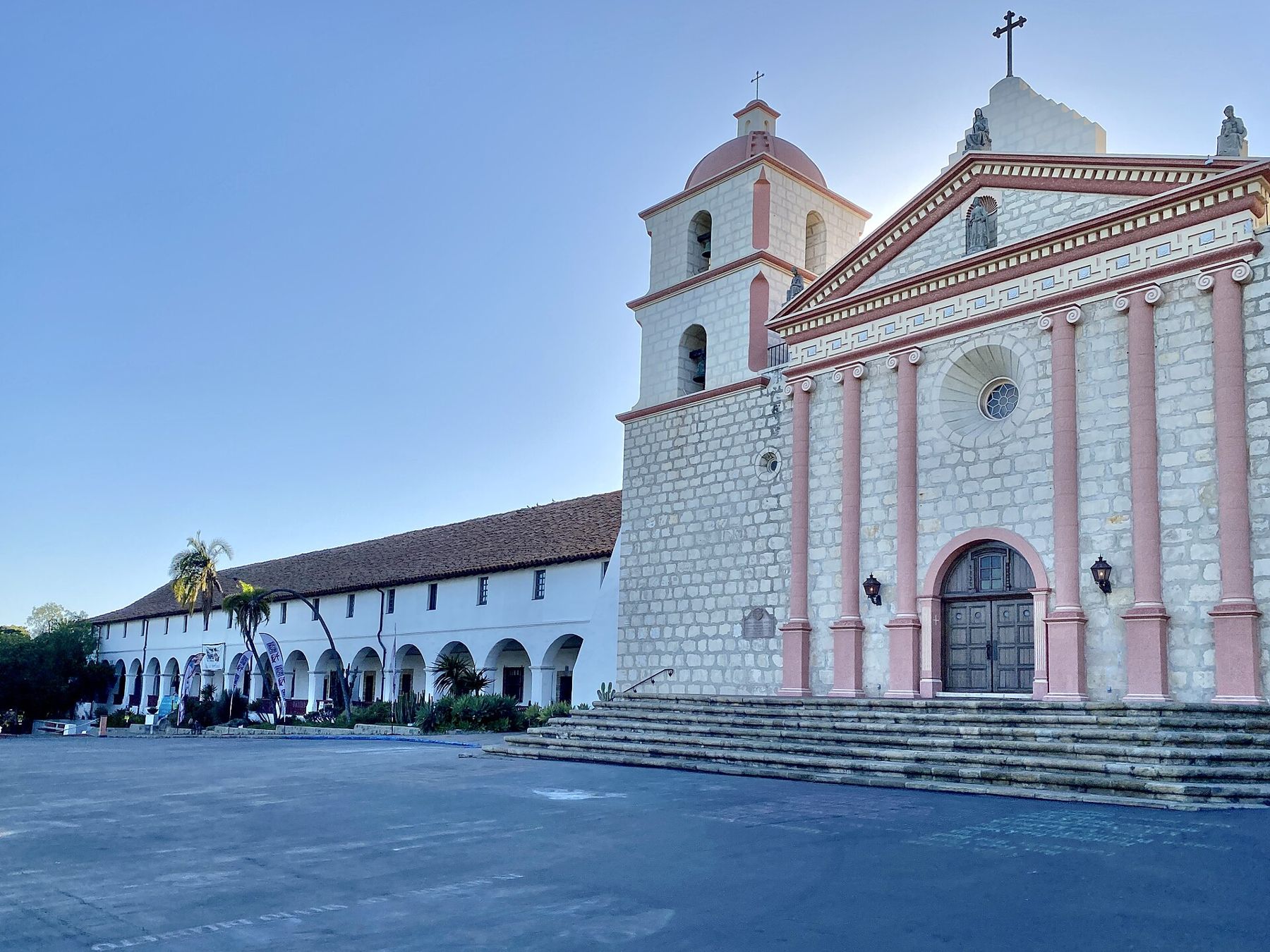
Leave at the end of the day if you have the choice. As the sun goes down behind the Mesa, the stone of the facade turns warm, the domes on the towers go deep pink, and the bells are silhouetted in their arches against the last of the light.