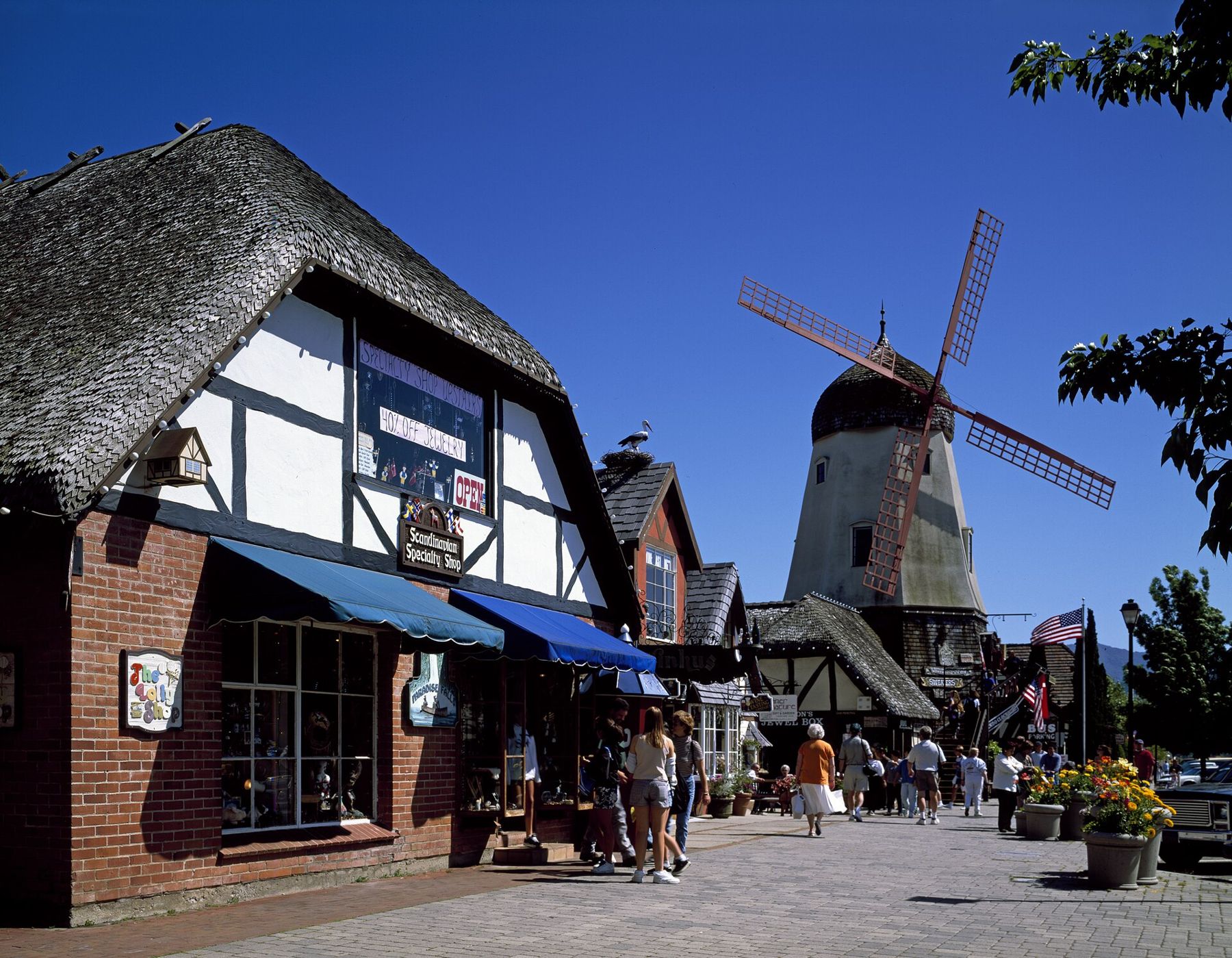
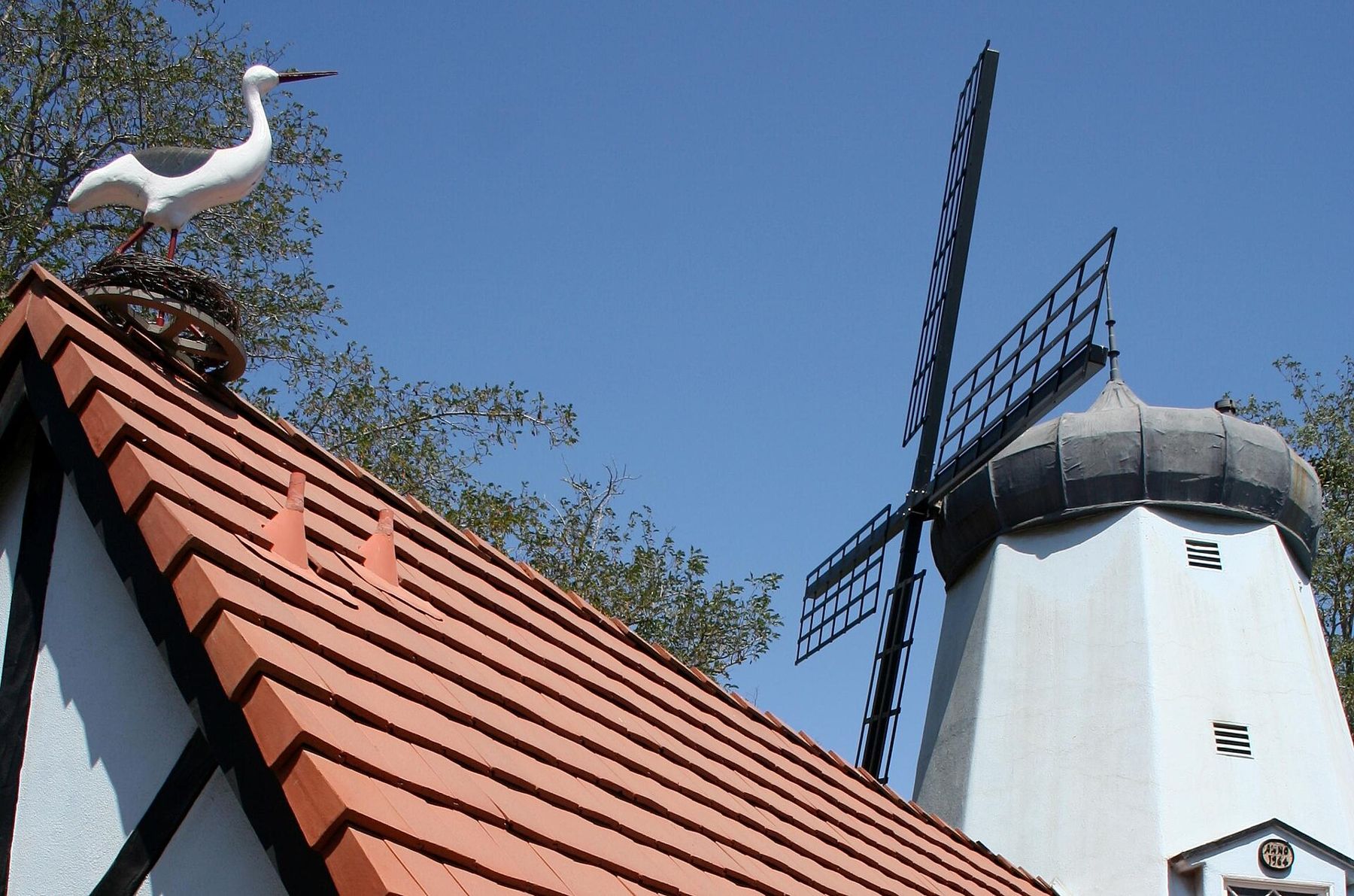
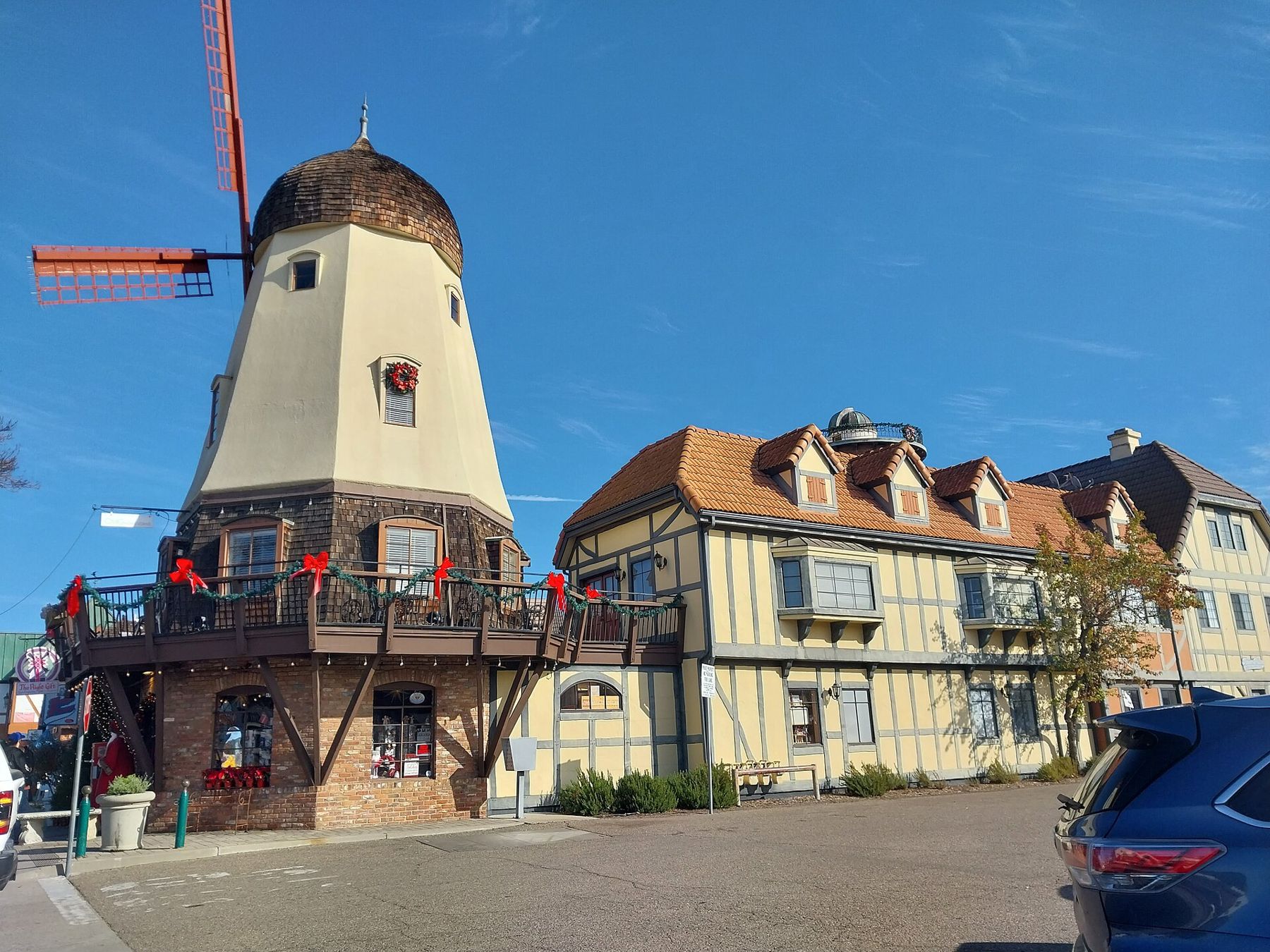
The first thing you notice coming down Highway 246 is a windmill. Then another one. Their sails stand out against a sky that is bigger and bluer than the sky over the coast, above rooftops of steep shingle and half-timbered walls, while all around them the hills are California gold and dotted with valley oaks. A wooden stork keeps watch from a gable. Somewhere a bakery is frying dough.
Solvang is a Danish village in the Santa Ynez Valley, and it is easy to be cynical about it. The windmills are decorative. The thatch is often fake. But the town is not a theme park built from nothing. It was founded by Danes, and the Danish look it wears today was chosen by their children and grandchildren, deliberately, more than seventy years ago. The story underneath the costume is worth knowing.
A Danish colony in 1911
In 1911 a group of Danish-Americans from the Midwest came west looking for land. They were led by Lutheran pastors and teachers who wanted to build a Danish community in California, with a church and a folk school where young people could learn the language, songs and traditions of the old country. They bought several thousand acres of an old Mexican land grant, Rancho San Carlos de Jonata, in the middle of the Santa Ynez Valley.
They named the place Solvang, Danish for "sunny field." The early settlers farmed, raised dairy cattle and built simple wooden houses that looked like any other farm town in California. The folk school, Atterdag College, opened a few years later and became the center of the colony's life.
For three decades, Solvang was simply a small agricultural community with Danish surnames, Danish services in the church and a good deal of Danish spoken at home.
How the village got its look
The change came after the Second World War. In the late 1940s, a national magazine published an article about the little Danish town in California, and visitors began to arrive looking for Denmark. Solvang decided to give it to them.
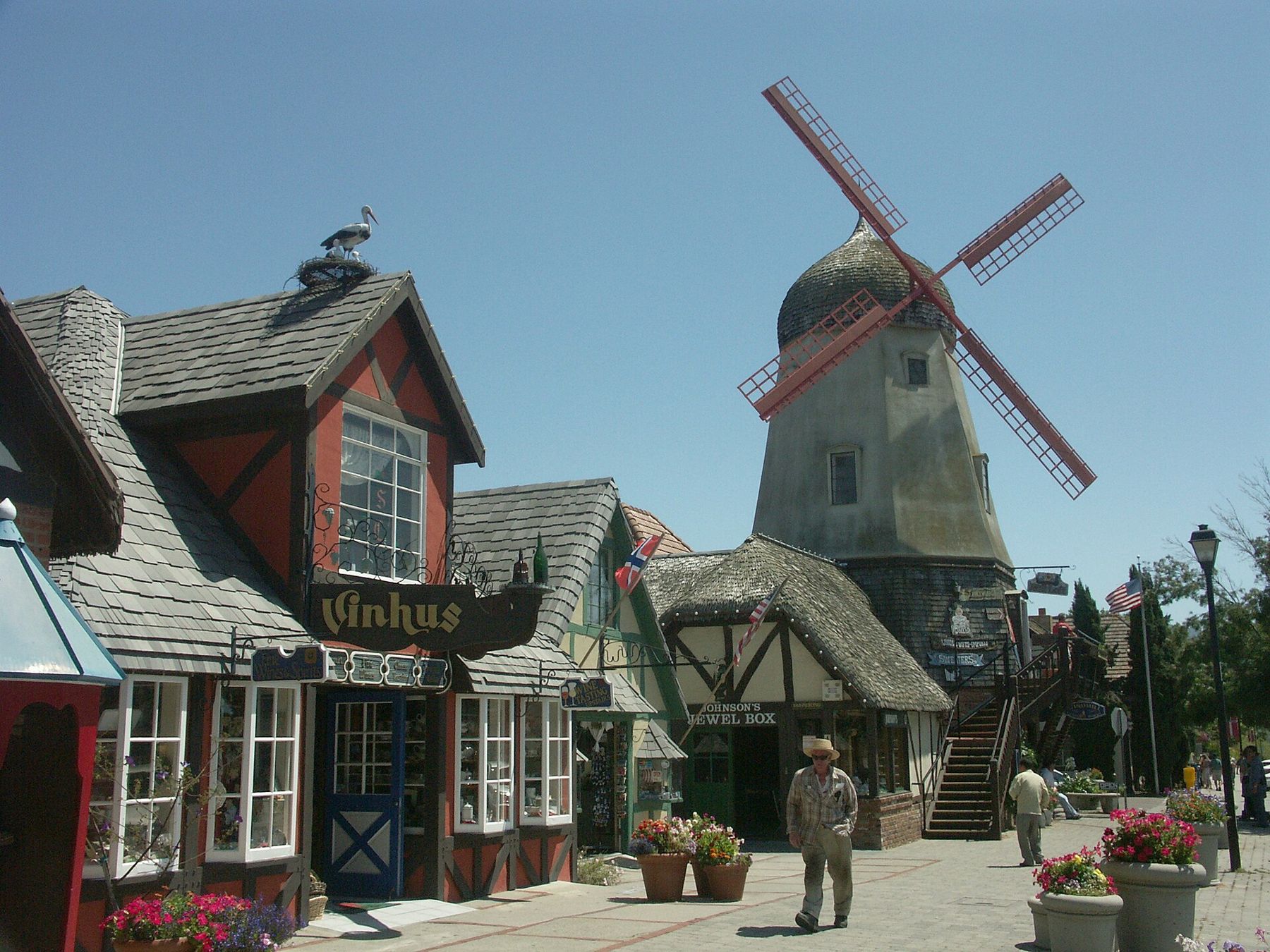
Business owners began to remodel their buildings in the Danish provincial style: half-timbering with brick or plaster between the beams, steep roofs, dormers, copper spires, painted trim and flower boxes. Windmills went up. Wooden storks, a Danish symbol of good luck, appeared on the roofs. The town adopted design rules to keep the look consistent, and it has stuck with them.
The result is a stage set, but a well-built and much-loved one. Some of the buildings are genuinely handsome, and the oldest of the Danish-style houses are now historic themselves. Look past the gift shops and you see the craftsmanship: carved beams, leaded windows, the careful lines of a roof built to shed snow that never comes.
The result is a stage set, but a well-built and much-loved one.
Windmills, a mermaid and Hans Christian Andersen
Walk the few blocks of the village center and the Danish references pile up. There are several windmills, some built as shops and one or two that look as if they could still grind. A smaller copy of the Little Mermaid, the statue that sits on the harbor in Copenhagen, perches on a rock above a fountain at the corner of Mission Drive and Alisal Road. A scaled-down replica of Copenhagen's Round Tower stands in the center of town.
Hans Christian Andersen, the Danish writer of fairy tales, is everywhere. Solvang has a small museum devoted to his life and work, with early editions of his books, letters and illustrations, and a park bears his name. Children who grew up on "The Ugly Duckling" and "The Little Mermaid" tend to recognize the town before the adults do.
For the history of the colony itself, a small museum in a Danish-style house built in the mid-twentieth century tells the story of the settlers, the folk school and the town's transformation, with furniture, photographs and household objects from Danish-American life.
Nearby, the Lutheran church that served the original congregation still stands. Built in a Danish country style, it has a model sailing ship hanging from the ceiling of the nave, a tradition in the churches of seafaring Denmark.
 Also on Presidio PostThe valley that runs the wrong way
Aebleskiver and the bakeries
For most visitors, Solvang is a place to eat. The Danish bakeries along Copenhagen Drive and Mission Drive have been turning out kringle, butter cookies, almond pastries and rye bread for generations, and the smell reaches the parking lots.
The local specialty is aebleskiver: round, puffy pancake balls cooked in a special cast-iron pan with half-spherical cups, turned with a skewer as they brown so they come out as perfect spheres. They are served hot, dusted with powdered sugar, with raspberry jam on the side. Several places make them, and you can watch the cooks turning them by hand.
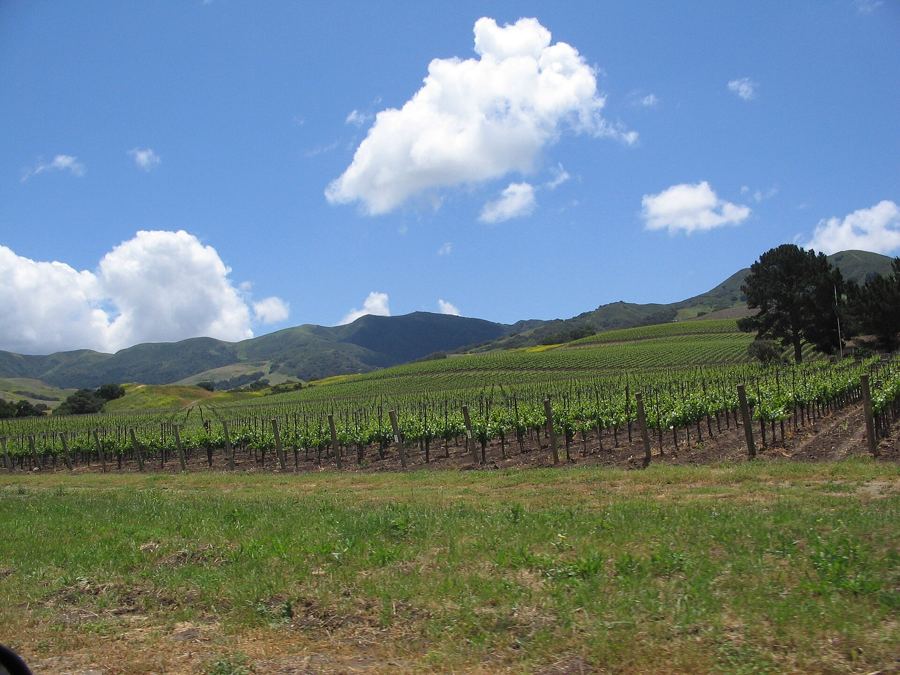
Wine has joined the pastry. In recent decades, as the Santa Ynez Valley became one of California's important wine regions, tasting rooms have opened in Solvang's half-timbered buildings. A town that once advertised Danish pastry now does a steady trade in Pinot Noir and Syrah, and a walk through the center can easily include both.
Mission Santa Inés next door
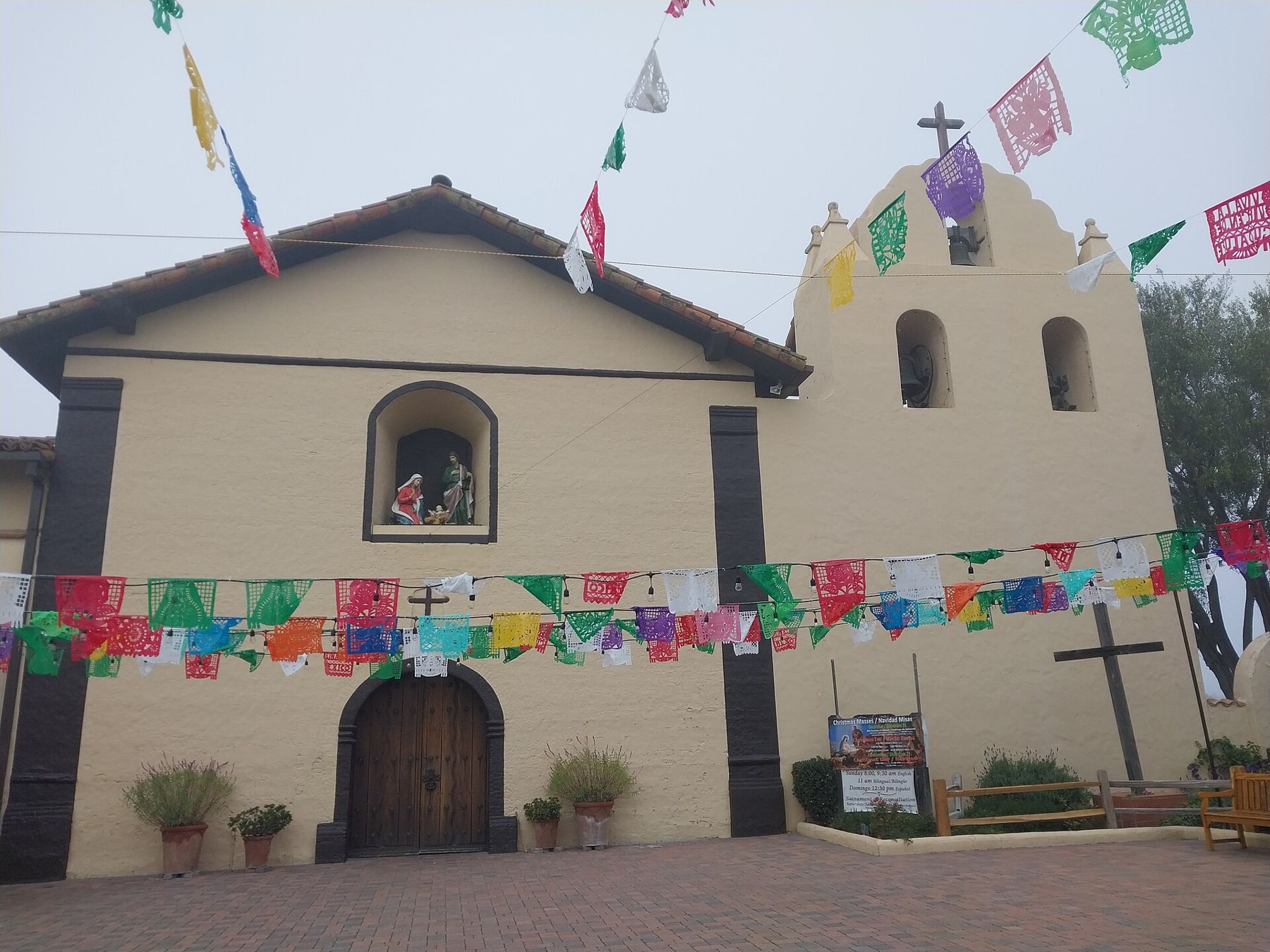
Long before the Danes, the valley belonged to the Chumash, and then to the Spanish missions. Mission Santa Inés stands at the eastern edge of Solvang, above the Santa Ynez River, and the contrast between the two is one of the oddities of California: a Spanish mission and a Danish village, side by side, a short walk apart.
The mission was founded in 1804, the nineteenth of the twenty-one California missions, to serve the Chumash of the interior valleys and link the coastal missions at Santa Barbara and La Purísima. Its buildings were damaged in the earthquake of 1812 and rebuilt. In 1824, the Chumash living at the mission rose against the soldiers and padres in a revolt that began here and spread to La Purísima and Santa Barbara, one of the most significant uprisings of the mission era.
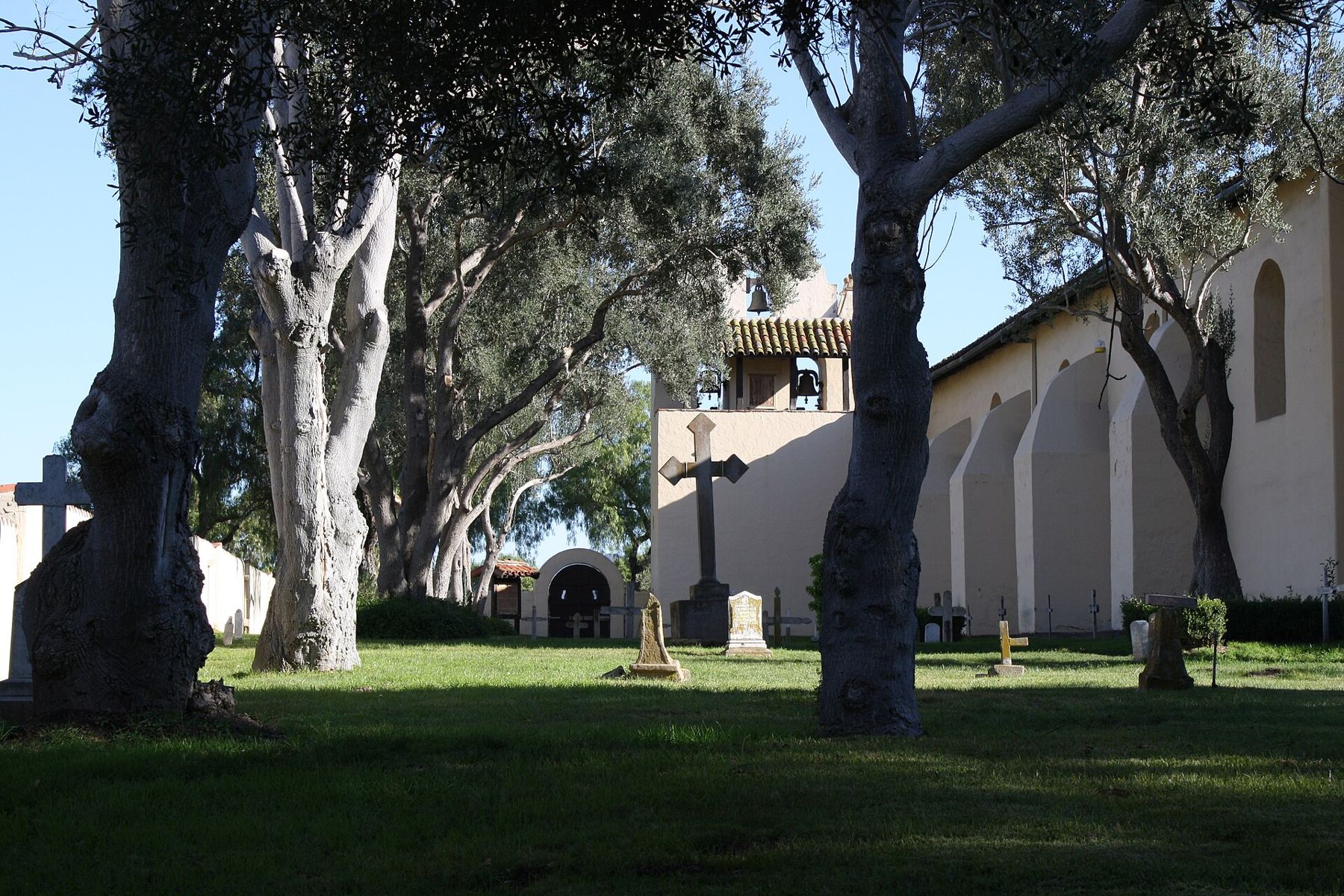
Today Mission Santa Inés is an active Catholic parish. Its long, plain church, white walls and simple bell wall sit above the river, with the Santa Ynez Mountains on the skyline. The museum displays vestments, paintings and objects from the mission's long history, and the cemetery and gardens behind it are quiet even when the village is crowded. If you have already seen Mission Santa Barbara, this is a revealing comparison: smaller, more rural and closer to what the missions were like as working places.
When to go
Solvang is busiest on summer weekends and holidays, when tour buses fill the lots and the sidewalks are crowded. Weekday mornings are calmer, and the light on the windmills is softer. In late winter and spring the surrounding hills are green, and in summer they turn gold and the valley gets hot, often much hotter than Santa Barbara.
Solvang is one of several small towns in the valley. Buellton lies just to the west, on Highway 101, and Santa Ynez, Ballard and Los Olivos lie a few miles to the east, each with its own character: Los Olivos with its flagpole and tasting rooms, Santa Ynez with its old Western main street, Ballard with its tiny 1880s schoolhouse. The Santa Ynez Band of Chumash Indians has its reservation near Santa Ynez, a reminder that the valley's first people never left. Many visitors combine two or three of these towns in a day.
Danish Days, held every September since the 1930s, is the town's big festival, with folk dancing, costumes, parades and aebleskiver eaten in the street. In December, the village puts up Christmas lights and the windmills are outlined against the night sky.
The drive over San Marcos Pass on Highway 154 takes about forty-five minutes to an hour from downtown Santa Barbara, past Lake Cachuma. Solvang pairs easily with a wine tasting route, a visit to Los Olivos, or a loop back to the coast along Highway 101 and the Gaviota coast.
Come late in the afternoon, after the buses leave. The shops start to close, the bakeries sell their last pastries, and the low sun turns the half-timbered walls gold. The windmills stand quiet against a darkening sky, and for a moment Solvang looks less like a stage set than a small farm town that dreamed itself into a different country.