The sun goes down behind the hills at the west end of the valley, and for a minute nothing happens. Then the cliffs at the east end catch fire. The Topa Topa bluffs, a long wall of rock above the orchards, turn from tan to orange, to rose, to a deep glowing pink, while the valley floor is already in shadow. It lasts a few minutes. Then the color drains upward, the rock goes gray, and the first stars come out over the citrus.
In Ojai they call it the pink moment, and people plan their evenings around it. It is the town's most famous sight and costs nothing, which suits a place that has always attracted artists, mystics, musicians and people who wanted to step slightly out of the world.
A valley that runs east to west
Ojai sits in a small, enclosed valley in Ventura County, about an hour's drive from Santa Barbara. Like the Santa Ynez Valley to the north, the Ojai Valley runs east to west, an unusual alignment for California, and that is the secret of the pink moment: at sunset, the bluffs at the eastern end face the sun head-on, lit up while the rest of the valley sits in shade.
The name is believed to come from the Chumash word for moon. The valley was ranch land and orchards in the nineteenth century, and its first town was called Nordhoff, after Charles Nordhoff, a journalist whose writing promoted California to the East. The town was renamed Ojai in 1917.
The valley is enclosed by mountains on all sides, which gives it a warm, dry climate unlike the foggy coast. Summers are hot. Winters can be crisp, with frost in the orchards. Citrus grows well, and Ojai is known in particular for the pixie tangerine, a small, sweet, seedless fruit that ripens in late winter and spring.
The Arcade and Libbey's town
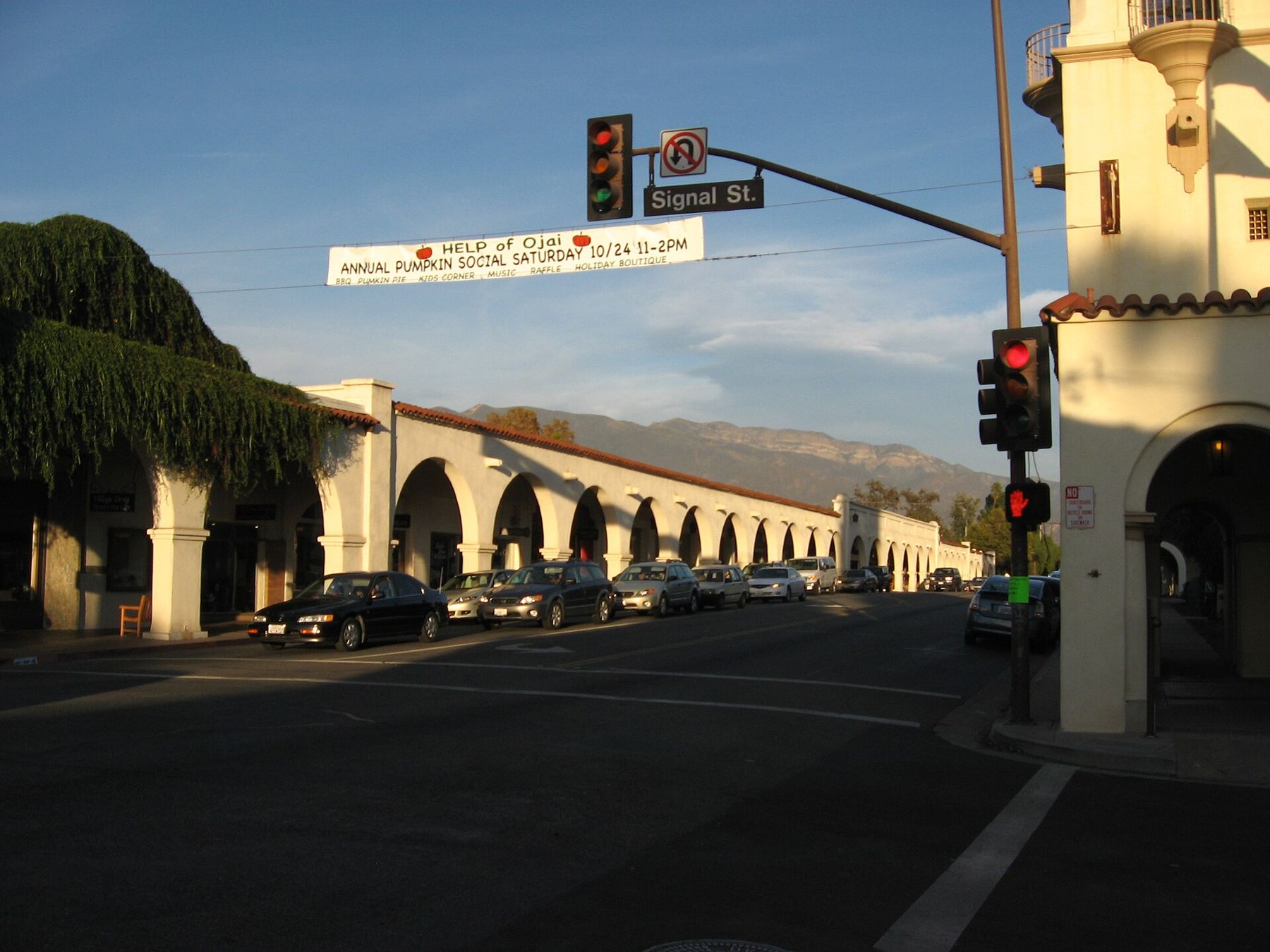
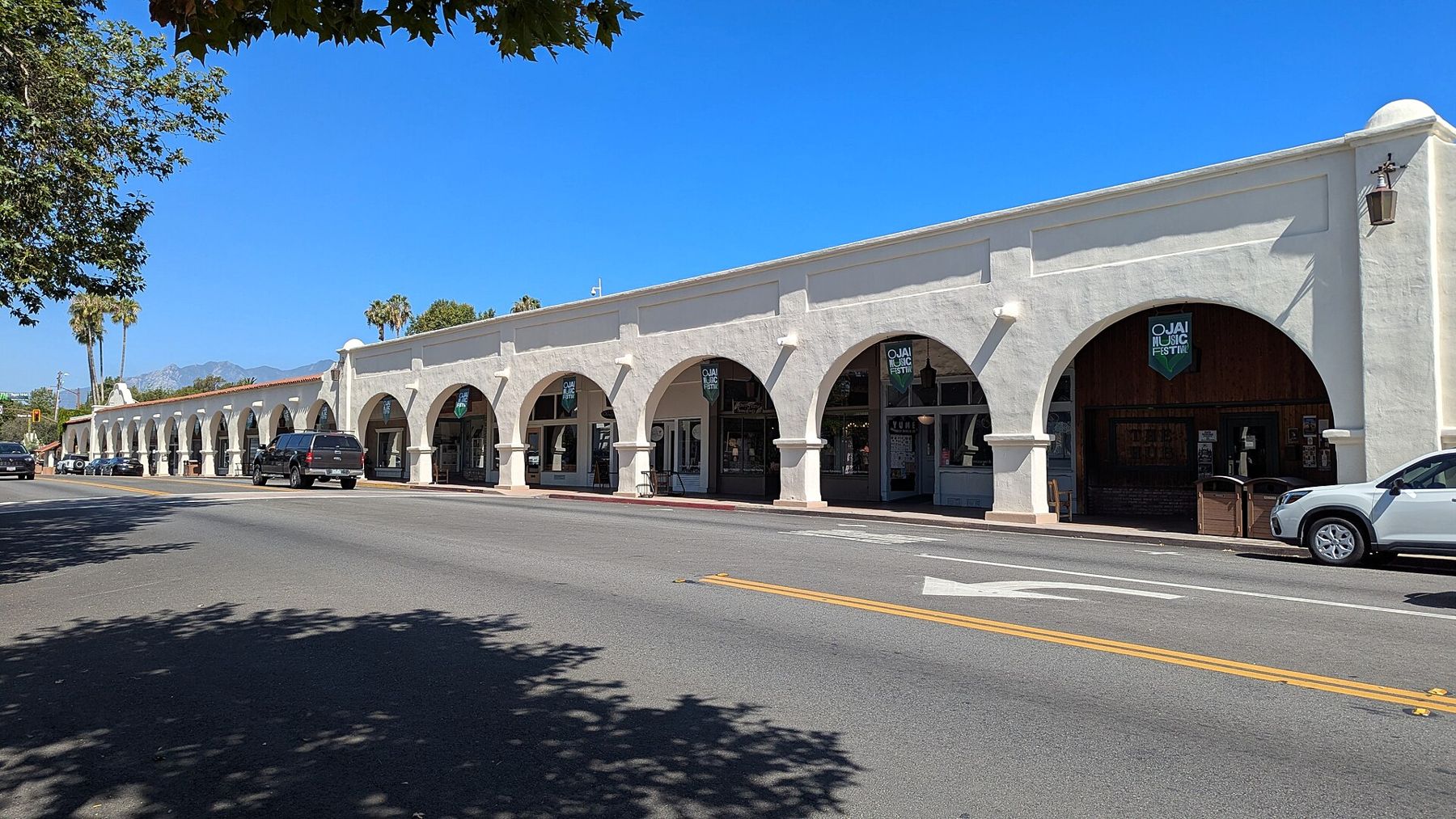
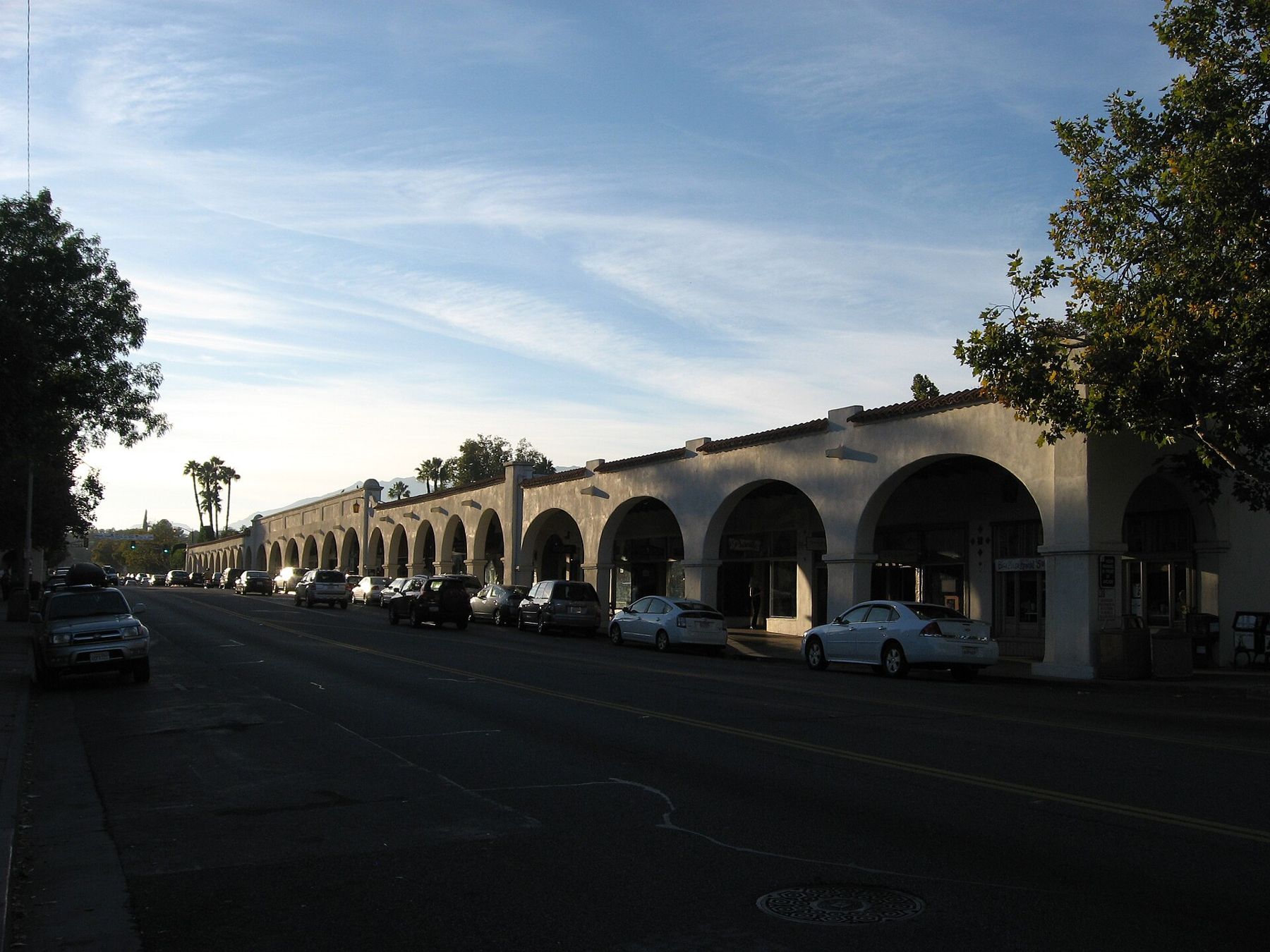
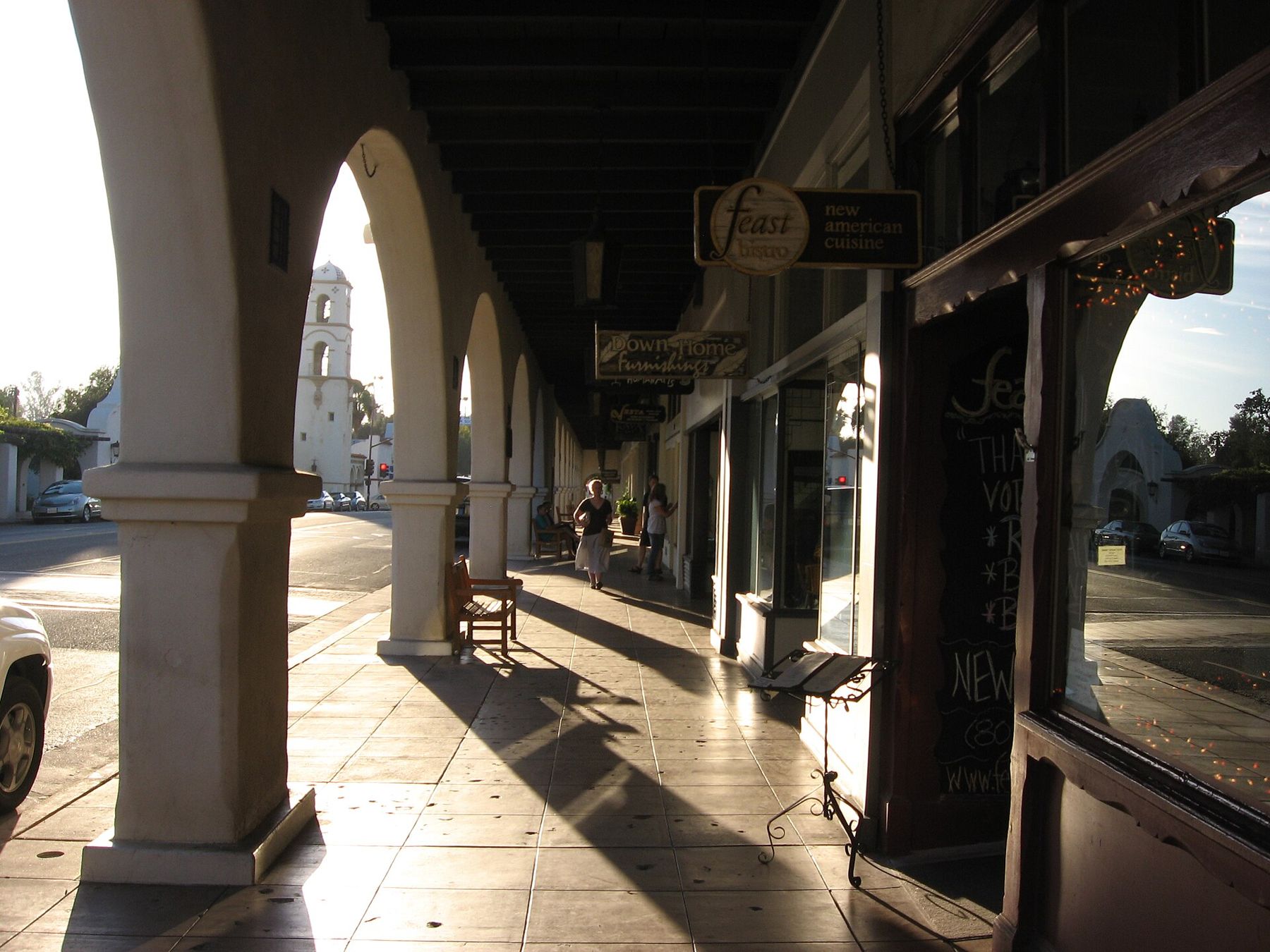
Downtown Ojai looks the way it does because of one man. Edward Libbey, the Ohio glass manufacturer, wintered in the valley and in the 1910s paid to rebuild the shabby main street in the Spanish Colonial Revival style. The result, finished around 1917, is the Arcade: a long row of white arches shading the sidewalk along Ojai Avenue, with shops, galleries and cafés behind it.
Across the street stand the post office, with its tall bell tower, and Libbey Park, a shady green with old oaks, a fountain and an open-air bowl. The architecture is a cousin of Santa Barbara's, built in the same years and with the same idea of a Spanish town in California. It works. Walking the Arcade on a warm afternoon, in the cool shade of the arches, with the tower ahead and the mountains beyond, is one of the pleasures of the valley.
The Ojai Music Festival, founded in 1947 and now held at the bowl in Libbey Park, brings serious contemporary and classical music to the bowl each year, and its programs have long had a reputation for adventure.
Bart's Books
A block off the main street, under an old oak, is one of the more unusual bookstores in California. Bart's Books has been selling used books since the 1960s, and most of them are outdoors. Shelves line the courtyard and paths of what was once a house, and the books sit under the sky, protected by awnings and the dry climate.
The custom that made it famous: a row of shelves faces the street outside the gate, and after hours, browsers can take a book and drop the payment through a slot in the door. It is an honor system that has lasted for decades.
Inside the gate, the stock is huge and wide-ranging, from paperbacks to rare editions. It is a place to lose an hour, then two.
 Also on Presidio PostWhere to watch the sun go down
The bluffs and the East End
The Topa Topa bluffs are the face of the Topatopa Mountains, a wall of pale sandstone that rises steeply above the eastern end of the valley. Behind them lies the Los Padres National Forest, a backcountry of canyons and ridges that has been part of the long effort to bring the California condor back from the edge of extinction. On a clear day, the great birds are sometimes seen riding the thermals over the high country.
The road east from town, past the last shops, leads into the East End, a quieter stretch of orchards, ranches and old farmhouses at the foot of the bluffs. Citrus and avocado groves line the roads, and in spring the air smells of orange blossom. Farm stands sell fruit by the bag in season, sometimes on the honor system.
For a walk with a view, Shelf Road is an old dirt road on the hillside above the north side of town, closed to cars and popular with walkers, runners and their dogs. It traces the slope above the orchards and looks across the whole valley to the hills on the far side. It is exposed and can be hot, so go early or late, carry water, and watch the trail edges for rattlesnakes in warm weather.
From the East End, the bluffs fill the sky. Stand among the trees at dusk and you see the pink moment at close range, the color climbing the rock face as the shadows rise from the orchards below.
The pursuit of quiet
Ojai has drawn spiritual seekers for a century. The Theosophists came in the 1920s and established a community here. The Indian philosopher Jiddu Krishnamurti, connected to the Theosophists in his youth, made the Ojai Valley his home for much of his long life, and his talks under the oaks drew audiences from around the world.
The spirit lingers in retreat centers, yoga studios and the general sense that the valley is a place to slow down. The most accessible of these places is Meditation Mount, at the east end of the valley on a ridge above the orchards. Its gardens of native and drought-tolerant plants are open to visitors, with paths, benches and a view down the length of the valley. At sunset it is one of the best places to watch the pink moment, facing the bluffs across the valley.
The rule there is quiet. Visitors come to watch, not to talk, and opening hours and access change, so check before going.
When it comes, the pink is brief and absolute.
Getting there and getting out
From Santa Barbara, the prettiest way to Ojai is Highway 150, which leaves the coast at Carpinteria, climbs into the hills past Lake Casitas, and winds down into the valley from the west. It is a narrow, curving road, slow but lovely, with views over the reservoir and the oak hills. Highway 33 from Ventura is faster, following the Ventura River north.
The Ojai Valley Trail, a paved path along an old railroad line, runs from Ojai down the river valley toward the coast and is popular with cyclists, walkers and riders. In town, everything is close enough to walk.
The valley has known fire. The Thomas Fire of December 2017 burned through the hills around Ojai, and the scars on the slopes will take years to heal. In summer and autumn, fire danger can be high and trails may close; check before hiking in the surrounding mountains. The valley is also prone to summer heat well beyond anything on the coast, so carry water even for a short walk.
The town is small but not sleepy. Ojai Avenue has galleries, potters, a long tradition of craft, and restaurants that lean on the produce of the surrounding farms. A weekly farmers' market draws growers from the valley. Ojai has also become a retreat for people from Los Angeles, and the mix of old ranch families, artists, spiritual seekers and weekenders gives the town its character: relaxed, a little eccentric, and fiercely protective of its small scale. Chain stores are rare, by design.
Stay for the evening. The day-trip visitors leave in the late afternoon, and the town relaxes. Find a spot facing east, at Meditation Mount, on a quiet road on the edge of town, or simply at the end of Ojai Avenue, and wait for the sun to drop behind you.
When it comes, the pink is brief and absolute. The whole wall of rock glows as if lit from within, the orchards go dark below it, and for those few minutes the valley seems to hold its breath.